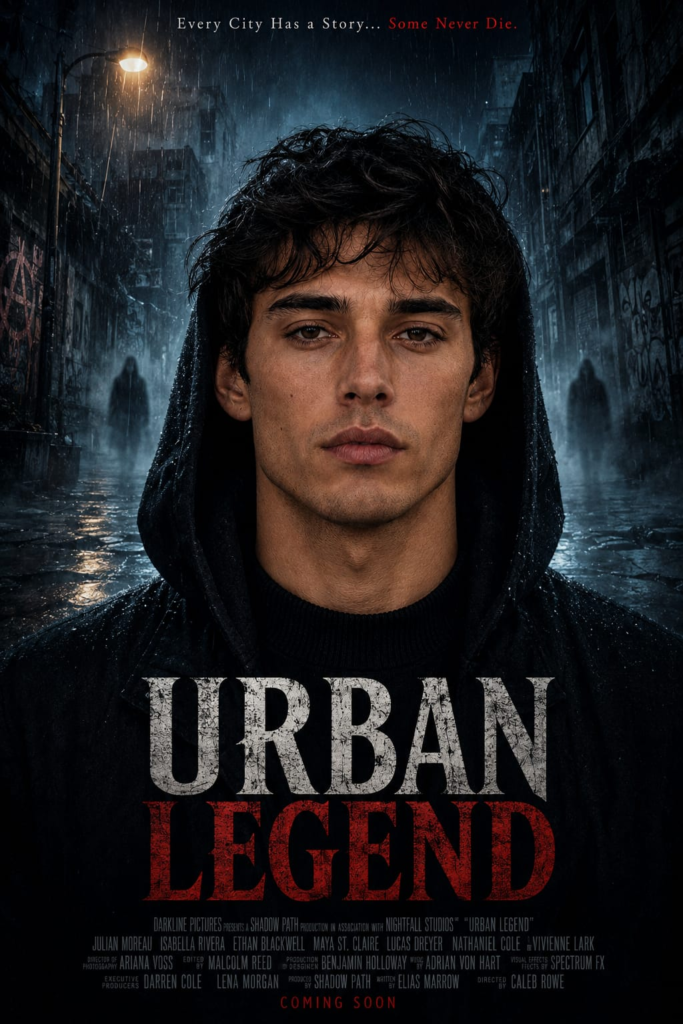
Ultra-realistic cinematic horror movie poster featuring the exact same person from the uploaded reference image, preserving 100% facial identity, hairstyle, facial structure, skin tone, eyebrows, eyes, lips, jawline, and all facial proportions with absolute accuracy. The character stands in the foreground, facing directly toward the camera with a calm yet unsettling expression, wearing a black hooded coat with the hood partially covering the head but leaving the entire face clearly visible and sharply illuminated. His face is the main focal point of the poster. Behind him stretches a deserted rain-soaked urban alley at midnight, lit only by a single flickering streetlight. Thick volumetric fog rolls across the cracked wet pavement, abandoned buildings with broken windows and faded graffiti loom on both sides, while long unnatural shadows extend toward the viewer. Subtle ghostly silhouettes emerge within the mist without revealing detailed faces, creating psychological horror instead of gore. Realistic rainfall, puddles reflecting city lights, cold blue moonlight mixed with teal-and-orange cinematic color grading, dramatic rim lighting outlining the character, soft light falling naturally across his face, intense eye contact with the viewer, ultra-detailed skin texture, realistic wet clothing, atmospheric depth, premium Hollywood horror aesthetic, IMAX-quality composition, film grain, HDR, 8K, photorealistic, masterpiece quality, centered composition, vertical 2:3 movie poster.
Tagline: "Every City Has a Story... Some Never Die."
Movie Title: "URBAN LEGEND" in large distressed cinematic typography across the lower center.
Important addition (to make the face visible):
Face occupies 30–40% of the poster
No mask, no face shadow, no face obstruction
Full front-facing portrait
Reference face must be instantly recognizable
Character in foreground, background horror elements secondary
This AI image prompt is designed to create a dark, cinematic psychological horror movie poster while keeping the main character’s recognizable facial identity as the most important visual element.
The character stands directly in the foreground, facing the camera with an unsettling but controlled expression. His black hooded coat and dramatic lighting establish the horror aesthetic, while the face remains fully visible and sharply illuminated.
The deserted rain-soaked alley creates the main environmental tension. Flickering streetlights, wet pavement, fog, broken windows, graffiti, and unnatural shadows create a mysterious urban atmosphere without relying on graphic violence or gore.
The central idea is psychological horror: something is present, but the viewer never fully understands what it is.
Understanding the Visual Style
The visual style combines Hollywood psychological horror, cinematic movie-poster photography, urban mystery, atmospheric thriller aesthetics, and ultra-realistic portrait photography.
The character is intentionally kept clearer and brighter than the background. This creates a strong visual hierarchy where the face becomes the first thing the viewer notices.
The hood partially frames the head but does not cover the face. This allows the character to maintain a mysterious appearance while keeping the facial features recognizable.
Ghostly silhouettes appear within the fog as secondary elements. They should remain vague and indistinct, creating suspense rather than turning the image into a creature-focused horror poster.
Technical Prompt Breakdown
The composition uses a front-facing portrait with the character occupying approximately 30–40% of the poster.
Keeping the face large within the frame helps preserve facial visibility and makes the character immediately recognizable.
The vertical 2:3 movie-poster format provides enough space for the character, alley, atmospheric elements, movie title, and tagline.
The prompt emphasizes sharp facial details, realistic skin texture, wet clothing, rainfall, atmospheric depth, HDR, film grain, and 8K photorealism to create a premium cinematic finish.
The background is intentionally softer than the face so that horror elements remain atmospheric rather than competing with the main character.
Lighting, Colors & Composition
The lighting combines cold blue moonlight with teal-and-orange cinematic color grading.
A subtle rim light outlines the character against the dark environment, while soft frontal illumination keeps the entire face visible.
The wet pavement reflects streetlights and surrounding colors, creating additional depth and visual interest.
Thick volumetric fog fills the alley and partially hides the distant horror elements. Long unnatural shadows extend toward the viewer, creating the impression that something unseen is approaching.
The composition remains centered, with the character’s face as the primary focal point and the alley creating strong perspective lines behind him.
Horror Atmosphere
The horror should remain psychological and atmospheric rather than graphic.
The deserted alley, broken windows, flickering streetlight, heavy rain, fog, silhouettes, and unnatural shadows create suspense without requiring gore.
The ghostly figures should remain partially hidden and blurred. Their lack of identifiable facial details makes them more mysterious and allows the viewer to imagine what might be inside the fog.
The overall atmosphere should feel cold, lonely, mysterious, and unsettling.
How to Customize This Prompt
Change the Location
The urban alley can be replaced with a deserted subway station, abandoned hotel corridor, old hospital hallway, empty parking garage, foggy forest road, or forgotten industrial district.
Each location can create a different horror story while maintaining the same cinematic style.
Change the Horror Element
The distant silhouettes can be replaced with mysterious shadows, strange reflections, flickering lights, distant figures, or unexplained objects.
Keeping these elements subtle will preserve the psychological-horror atmosphere.
Change the Color Palette
The teal-and-orange grading can be replaced with cold blue monochrome, dark green, crimson-black, desaturated gray, or deep purple tones.
Cool blue-gray tones work especially well for a rainy urban horror setting.
Customize the Movie Typography
The title “URBAN LEGEND” can be replaced with an original fictional horror title.
The tagline “Every City Has a Story… Some Never Die.” can also be changed to create a different narrative theme.
Keep the typography distressed and cinematic while ensuring it does not overlap or obscure the character’s face.
Best Use Cases
This prompt works well for AI horror movie posters, psychological thriller concepts, cinematic character artwork, fictional movie campaigns, Instagram horror artwork, YouTube thumbnails, digital posters, creative portfolios, Halloween-themed content, and atmospheric storytelling visuals.
The concept is especially effective when the goal is to create suspense through mystery, darkness, isolation, fog, rain, and an unsettling character presence rather than graphic horror.
For commercial use, use original fictional movie titles, taglines, logos, and graphic elements, and check the AI generator’s licensing terms before publishing the final artwork.