
If you have ever typed “beautiful woman in garden, realistic photo, 8k” into an AI generator and received an unnervingly glossy, oversaturated image with plastic skin and dead eyes, you are familiar with the ambiguity trap.
Modern AI image models like Midjourney v6.1, Black Forest Labs Flux.1 (Dev & Schnell), ChatGPT (DALL-E 3), and Stable Diffusion XL are not mind readers. While they possess billions of trained neural connections spanning art history, optics, and human anatomy, they operate on mathematical probabilities. When your prompt is vague, the AI fills in the blanks using the most generic statistical averages.
To unlock museum-grade realism, cinematic emotion, and magazine-worthy compositions, you need a disciplined framework. In this definitive guide, we break down the 8 Best Practices for Writing Detailed AI Image Prompts—a battle-tested blueprint designed to give you consistent, high-fidelity results on every single render.
What are the 8 Best Practices for Writing Detailed AI Image Prompts?
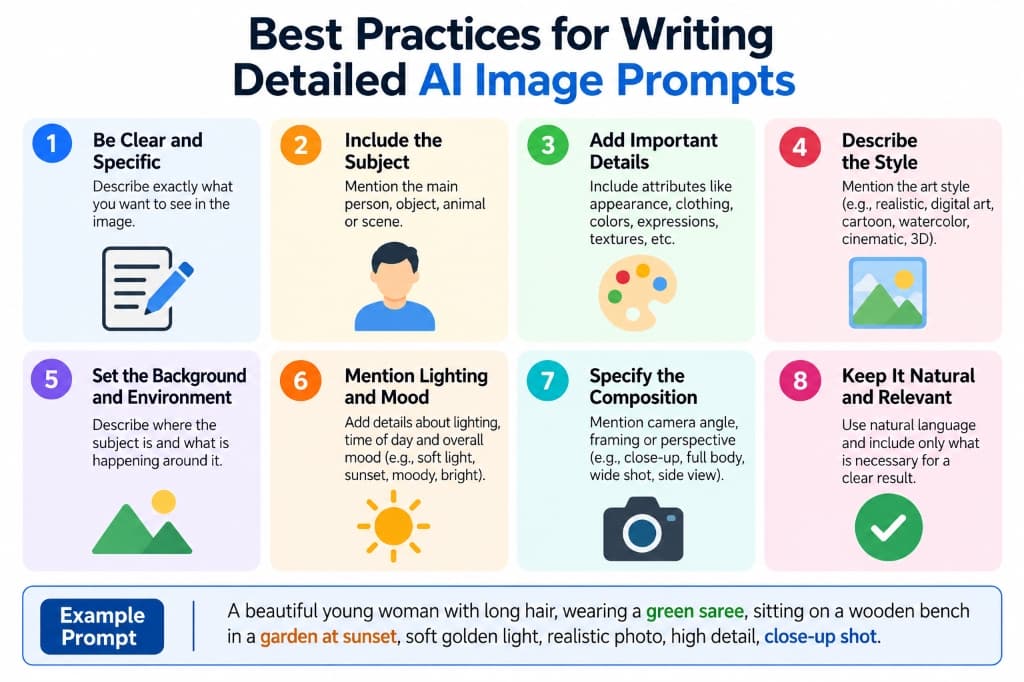
Writing a high-performing AI image prompt requires structuring your instructions into eight foundational layers that guide the model's latent diffusion process:
- 1. Be Clear and Specific: Describe exactly what you want to see; eliminate vague adjectives and replace them with concrete visual descriptors.
- 2. Include the Subject: Clearly identify the primary person, object, animal, or central focal point taking center stage.
- 3. Add Important Details: Specify physical attributes, clothing fabrics, authentic textures, color palettes, and facial expressions.
- 4. Describe the Style: Define the artistic medium (e.g., 35mm film photograph, digital concept art, watercolor wash, 3D Octane render).
- 5. Set the Background and Environment: Anchor the subject in a tangible space with atmospheric depth, weather, and world-building elements.
- 6. Mention Lighting and Mood: Dictate light direction, color temperature, and emotional atmosphere (e.g., golden hour, moody chiaroscuro, soft diffused window light).
- 7. Specify the Composition: Direct the virtual camera lens with exact framing (close-up, wide shot, rule of thirds) and camera angles (eye-level, low angle).
- 8. Keep It Natural and Relevant: Write in natural, grammatical sentences; avoid token clutter, spammy buzzwords (“photorealistic 8k”), and contradictory tokens.
Deconstructing the Featured Prompt Formula
Let us examine the exact prompt demonstrated in our visual infographic blueprint:
“A beautiful young woman with long hair, wearing a green saree, sitting on a wooden bench in a garden at sunset, soft golden light, realistic photo, high detail, close-up shot.”
Notice how this single, elegant sentence achieves complete visual harmony without unnecessary hype words. Here is how each phrase maps to our 8 best practices:
| Prompt Snippet | Core Pillar | Why It Works |
|---|---|---|
A beautiful young woman with long hair | Pillars 1 & 2: Subject & Clarity | Establishes a human focal point immediately. Tells the neural net to prioritize portrait geometry and hair flow. |
wearing a green saree | Pillar 3: Important Details | Supplies both clothing type and specific color, preventing the AI from guessing an unintended modern or western outfit. |
sitting on a wooden bench in a garden | Pillar 5: Setting & Environment | Provides physical grounding and natural environment context (rustic wood, botanical foliage). |
at sunset, soft golden light | Pillar 6: Lighting & Mood | Determines color temperature (warm amber), shadow softness, and romantic ambiance. |
realistic photo, high detail | Pillar 4: Describe Style | Directs the model away from stylized 3D cartoons or anime toward lifelike photographic rendering. |
close-up shot | Pillar 7: Composition | Positions the virtual camera close to the face and shoulders, creating intimacy and rich depth-of-field blur (bokeh). |
Natural English phrasing | Pillar 8: Natural & Relevant | Natural grammatical syntax guides modern Transformer text encoders (T5 in Flux, CLIP in Midjourney) far better than random comma dumps. |
Pillar 1: Be Clear and Specific (Semantic Precision)
The single most common mistake beginners make is using subjective, empty adjectives like “cool”, “epic”, “amazing”, or “insane”. An AI neural network has no biological concept of what “cool” means—it only understands mathematical correlations between words and pixels.
Semantic Precision means substituting vague generalizations with tangible, concrete nouns and physical descriptions:
- ❌ Vague: “A handsome man in a cool jacket.”
- ✔ Clear & Specific: “A 30-year-old Scandinavian man with sharp cheekbones and stubble, wearing a weathered brown leather bomber jacket with a shearling wool collar.”
When you name specific materials (shearling wool, weathered leather), eras (Scandinavian contemporary, 1970s retro), or physical anatomy (sharp cheekbones, almond-shaped hazel eyes), you restrict the model's latent space to the exact aesthetic you desire.
Pillar 2: Include the Subject (Focal Hierarchy)
Every great image has a clear hero. The subject is the gravitational center of your composition. Placing your subject at the front of your prompt leverages token positioning weight—most diffusion architectures assign slightly higher priority to words appearing in the initial 20–30 tokens.
Tips for Defining Your Subject:
- State the primary entity first: Start with “A cybernetic Bengal tiger”, “An elderly Japanese watchmaker”, or “A vintage espresso machine”.
- Define the action or pose: Avoid static mannequins. Use active verbs: “inspecting a tiny brass gear through an eye loupe” or “crouched mid-stride atop a neon-lit rain-slicked roof”.
- Avoid subject clutter: Demanding three different people doing three complex independent actions in one prompt frequently leads to merged limbs and hallucinated anatomy. If you have secondary subjects, explicitly subordinate them (e.g., “in the background, blurred pedestrians walk beneath umbrellas”).
Pillar 3: Add Important Details (Textures, Clothing & Expressions)
Details are what separate an image that looks “obviously AI-generated” from one that captures breathtaking realism. In human perception, reality is conveyed through imperfections, tactile surfaces, and emotional nuance.
Fabric & Material Textures
Specify weave and surface qualities: ribbed cotton, raw denim, embroidered gold silk, hammered brass, brushed titanium, polished mahogany, wet cobblestone.
Human Skin & Physicality
Guide realistic skin rendering: authentic skin pores, subtle laugh lines, natural skin texture, delicate freckles across the nose bridge, subsurface scattering.
Facial Expression & Gaze
Replace blank stares with intent: wistful smile, intense contemplation, gentle laughter, piercing direct eye contact with the viewer, calm serenity.
Pillar 4: Describe the Style (Photorealistic, Digital, 3D, Watercolor)
Without an explicit style modifier, diffusion models often produce an awkward hybrid—partly 3D render, partly airbrushed photo. Naming your artistic medium sets the visual grammar for the entire image.
Core Art Styles and Keywords for 2026:
- Photorealism / Photography: “Editorial fashion photography, 35mm film still, National Geographic documentary portrait, Kodak Portra 400 color science, crisp optical focus.”
- Digital Painting & Concept Art: “Digital fantasy illustration, textured matte painting, sweeping brushstrokes, ArtStation keyframe, detailed character concept art.”
- 3D CGI & Modern Rendering: “3D character render, Octane render, ray-traced reflections, Unreal Engine 5 aesthetic, volumetric subsurface glow.”
- Traditional Fine Art: “Expressive watercolor wash on rough paper, impasto oil painting with heavy palette knife textures, charcoal sketch with crosshatching.”
- Anime & Cel-Shaded: “Modern cinematic anime aesthetic, clean line art, vibrant cel-shaded palette, Studio Ghibli inspired background art.”
Pillar 5: Set Background and Environment (World-Building)
A subject floating in a void or against a generic blur immediately feels artificial. Giving your subject a tangible environment creates narrative depth and realism.
Professional prompt engineers structure environments across three spatial planes:
- Foreground: Elements close to the lens that frame the shot (e.g., out-of-focus tropical leaves, raindrops on a coffee shop window, dust motes dancing in light).
- Midground: Where your subject lives and interacts (e.g., sitting on a weathered wooden park bench, leaning against a neon shop counter).
- Background: The distant world-building backdrop (e.g., misty Himalayan mountain ridge, towering cyberpunk skyscrapers with flying vehicles, glowing sunset horizon).
Pillar 6: Mention Lighting and Mood (The Secret to Quality)
In cinema and photography, light is not merely illumination—it is storytelling. The exact same person sitting in the same chair looks cheap and flat under fluorescent ceiling light, but looks mesmerizing under golden hour rim lighting.
| Lighting Style | Visual Effect & Keywords | Best Used For |
|---|---|---|
| Golden Hour | “Warm golden hour sunlight, low sun angle, long soft shadows, amber rim lighting” | Outdoor portraits, wedding photography, pastoral landscapes, nostalgic moods. |
| Blue Hour / Twilight | “Deep cobalt twilight, soft ambient dusk, subtle mist, cool atmospheric tones” | Moody urban streets, architectural exteriors, serene waterscapes, reflective emotions. |
| Studio / Softbox | “Diffused large softbox key light, gentle fill light, subtle catchlights in eyes” | Commercial headshots, fashion lookbooks, beauty portraits, product photography. |
| Volumetric God Rays | “Atmospheric volumetric sunbeams streaming through dusty windows, hazy god rays” | Cathedrals, dense forest canopies, vintage libraries, epic fantasy interiors. |
| Chiaroscuro & Neon | “High contrast chiaroscuro, moody shadows, saturated magenta and cyan neon backlight” | Cyberpunk alleys, film noir detective scenes, dramatic character portraits. |
Pillar 7: Specify the Composition (Camera Angles & Optics)
Telling the AI where to place its camera gives you direct control over perspective, scale, and emotional intimacy.
1. Camera Framing
- Extreme Close-Up (ECU): Focuses on a single detail—eyes, lips, jewellery, or intricate watch gears.
- Close-Up (CU): Head and shoulders portrait with pronounced shallow depth-of-field (creamy bokeh).
- Medium Shot (MS): Waist up; balances subject expression with clothing and immediate environment.
- Full-Body Wide Shot: Captures entire figure from head to toe within the vast landscape.
2. Camera Angles
- Eye-Level Shot: Neutral, authentic, natural human perspective.
- Low-Angle Shot (Worm's-Eye): Looking upward; conveys power, heroic majesty, and monumental scale.
- High-Angle / Bird's-Eye View: Looking downward; conveys vulnerability, spatial layout, or architectural symmetry.
- Dutch Angle: Tilted horizon line; induces tension, kinetic action, or psychological unease.
Pillar 8: Keep It Natural and Relevant (Modern Token Economy)
In early 2022, AI prompt engineering relied on “tag soup”—stuffing prompts with 30 disconnected keywords separated by commas like “photorealistic, 8k, unreal engine, masterpiece, trending on artstation, octane render, ultra detailed”.
In 2026, modern models powered by T5-XXL (Flux.1) and GPT-4 vision decoders (DALL-E 3) treat prompts as natural language. Keyword stuffing actually harms image generation by causing token dilution:
- Every word has weight: If your prompt is 80 words long and 40 of them are spam words like “hyper-realistic 8k”, the model dilutes its attention away from your actual subject, clothing, and lighting.
- Prepositions matter: Phrases like “sitting on a wooden bench” or “holding an ornate ceramic cup with both hands” communicate spatial relationships that comma lists completely fail to capture.
- Avoid negative repetition: Instead of shouting “no ugly faces, no bad hands” in your positive prompt (which often tricks the model into thinking about bad hands!), describe what you want to see: “hands with gracefully curved fingers resting lightly on her lap, clean natural anatomy”.
6 Tested Copy-Paste Prompts Across Popular Genres
Here are six production-ready prompts constructed strictly using the 8-pillar blueprint. Copy, paste, and adapt them to your creative vision:
“Close-up portrait of an elegant young Indian woman with radiant complexion and long dark hair, wearing an emerald green silk saree with delicate gold zari embroidery. She is seated gracefully on an antique wooden bench in a blooming jasmine garden at sunset. Soft warm golden hour sunlight illuminates her silhouette, creating gentle lens flare and natural skin texture. Photorealistic documentary style, 85mm lens, shallow depth of field, creamy bokeh background.”
“Medium shot of a focused cyber-security specialist standing in a rain-slicked Tokyo alleyway at night. She wears an oversized matte black techwear jacket with subtle glowing orange fiber-optic seams and wireless augmented reality glasses reflecting green holographic data code. The background features towering skyscrapers bathed in magenta and cyan neon signs, with steam rising from sewer grates. Cinematic anamorphic 35mm film still, sharp rim lighting, reflective water puddles.”
“Eye-level close-up of an artisan ceramic mug filled with velvety cappuccino, featuring an intricate rosetta latte art pattern on dense microfoam. The mug rests on a rustic dark walnut café table beside roasted coffee beans and an open leather journal. Soft morning sunlight streams through a nearby window, illuminating delicate steam wisps rising into the air. High-end editorial food photography, 50mm macro lens, rich textures, warm cozy aesthetic.”
“Wide-angle architectural interior photograph of a minimalist Japandi living room. Features low-profile light oak furniture, a beige textured linen sectional sofa, and a large bonsai tree in a hand-thrown ceramic pot. Floor-to-ceiling glass doors open into a bamboo courtyard during soft overcast morning light. Diffused neutral illumination, balanced linear perspective, Architectural Digest editorial quality, serene and uncluttered mood.”
“Majestic celestial stag standing proudly on a mossy cliff edge inside an ancient enchanted forest. Its magnificent translucent crystalline antlers pulse with subtle turquoise bioluminescence, casting a gentle glow onto the surrounding damp fern leaves and floating spore particles. Midnight atmosphere with silvery moonlight filtering through the dense canopy. Digital fantasy art, highly detailed concept art, Octane 3D render style, epic mythical scale.”
“Candid documentary street photograph taken on a brisk autumn afternoon in 1970s London. An elderly man wearing a charcoal tweed overcoat and flat cap walks past a classic red telephone booth, holding a folded daily newspaper under his arm. Golden autumn leaves scatter across the damp pavement as a vintage double-decker bus passes in the blurred background. Authentic Kodak Kodachrome 64 film grain, warm muted vintage tones, natural street candid.”
Comparison: Weak Prompt vs. 8-Pillar Detailed Prompt
To understand the immense difference structured prompting makes, observe this side-by-side contrast of the same creative concept:
| Dimension | ❌ Weak / Beginner Prompt | ✔ 8-Pillar Detailed Prompt |
|---|---|---|
| Prompt Text | “A woman in green saree in a garden, realistic, 8k, photorealistic, trending on artstation” | “A beautiful young woman with long hair, wearing an emerald green silk saree, sitting on a wooden bench in a garden at sunset, soft golden light, realistic photo, high detail, close-up shot.” |
| Subject Definition | Vague (“a woman”); model chooses random age, expression, and pose. | Clear subject hierarchy (“young woman with long hair, sitting on a bench”). |
| Lighting & Optics | Unspecified; results in flat, clinical, or artificial fluorescent studio flash. | Specific golden hour sunset light with directional warmth and soft shadows. |
| Camera Framing | Undefined; AI guesses random crop, often chopping off feet or awkward torso angles. | Explicit “close-up shot” with shallow depth of field focusing on facial expression. |
| Typical AI Output | Plastic over-smoothed skin, cartoonish glossy eyes, muddy background foliage. | Authentic skin pore texture, realistic fabric drape, creamy bokeh, natural cinematic beauty. |
Model-Specific Best Practices: Midjourney v6 vs. Flux.1 vs. ChatGPT
While the 8 pillars apply universally, each major 2026 AI model has specific architectural strengths you should tailor for:
Midjourney v6.1
- Thrives on artistic framing, camera lenses (e.g. 85mm f/1.4), and film stocks.
- Use parameters:
--ar 16:9(cinematic) or--ar 4:5(portrait). - Use
--stylize 150to250for artistic flair, or--style rawfor documentary realism without AI embellishment.
Black Forest Labs Flux.1
- Powered by a 12B parameter Transformer text encoder (T5-XXL); understands complete sentences better than any other model.
- Excels at complex spatial positioning: “holding X in left hand while looking over right shoulder at Y”.
- Zero need for buzzwords like “hyperrealistic”; natural descriptive prose produces the cleanest photorealism.
ChatGPT (DALL-E 3)
- Best-in-class at rendering exact text inside signs, banners, clothing, and books.
- Automatically expands simple prompts behind the scenes; be very explicit if you want a specific photographic look.
- Instruct it directly: “Do not modify or embellish this prompt; render it literally as written.”
Frequently Asked Questions (FAQ)
Do keywords like “photorealistic”, “8k”, and “trending on Artstation” still help in 2026?
No. In modern 2026 models (Flux.1, Midjourney v6+, DALL-E 3), these keywords are obsolete and counterproductive. They cause token dilution and often trigger over-smoothed, plastic aesthetics associated with 2022 dataset tags. Instead, describe real photographic attributes: “35mm film photograph, Kodak Portra color grading, authentic skin pores, 85mm lens f/1.8.”
Should I write my prompt as one flowing paragraph or separate tags with commas?
Modern models perform best with flowing, natural sentences that describe spatial relationships and actions. A hybrid structure is ideal: start with a natural sentence identifying the subject, action, clothing, and setting, followed by short photographic descriptors specifying lighting, camera angle, and lens optics.
How do I stop AI models from mangling hands and fingers?
Give the hands a specific, physical job. Instead of leaving hands idle where the model must invent ambiguous finger arrangements, prompt active engagement: “hands holding a vintage brass pocket watch with both thumbs resting on the casing” or “hands tucked into jacket pockets” or “fingers interlaced gracefully on her lap”.
What is the ideal prompt length for detailed AI images?
Between 30 to 75 words is the sweet spot for most diffusion models. Prompts under 15 words leave too much to random chance, while prompts exceeding 120 words suffer from token attention decay where the model forgets instructions placed near the end.
Ready to Practice? Explore Free AI Prompts on EmtyBrain
Browse thousands of curated, copy-paste AI prompts across photography, digital art, portraits, and 3D renders. Test them in your favorite generator today!
Comments & Discussion 0
Join the conversation, ask questions about this guide, or share your AI creations.
No comments yet
Be the first to share your thoughts, tips, or ask a question!