
If you have ever typed “a girl on a mountain at sunset” into an AI image generator and received a blurry, plastic-looking mannequin with lifeless lighting, you are not alone.
More than 90% of beginners struggle to get consistent results from AI tools like Midjourney, ChatGPT (DALL-E 3), Flux, and Google Gemini. The problem isn't the AI model—it's the way we communicate with it. AI generators do not think in vague concepts; they synthesize images pixel-by-pixel based on structured visual descriptors known as prompt architecture.
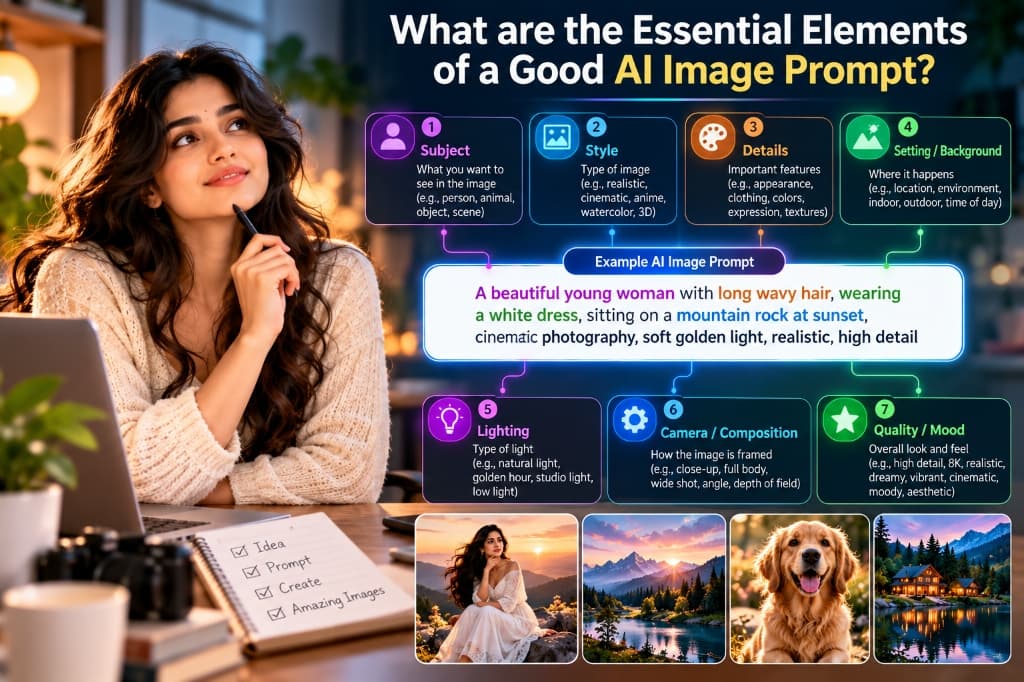
In this masterclass guide, we deconstruct the 7 essential elements of a good AI image prompt based on our visual blueprint. By mastering these seven pillars, you can transform simple ideas into magazine-quality portraits, cinematic landscapes, and viral social media visuals.
What are the 7 Essential Elements of a Good AI Image Prompt?
A high-performing AI image prompt is composed of seven distinct layers that give the generative model complete visual clarity:
- 1. Subject: What you want to see in the image (e.g., person, animal, object, architecture, character).
- 2. Style: The artistic medium or render format (e.g., photorealistic, cinematic 35mm, anime, watercolor, 3D clay).
- 3. Details: Specific features, clothing, physical appearance, colors, tactile textures, and facial expressions.
- 4. Setting / Background: The environment, geographical location, time of day, weather, and background depth.
- 5. Lighting: Direction, warmth, and source (e.g., golden hour rim light, diffused softbox, moody candlelight, neon reflections).
- 6. Camera / Composition: Lens focal length, shot angle, framing (e.g., 85mm portrait, close-up, wide-angle, rule of thirds, bokeh).
- 7. Quality / Mood: Overall emotional tone and color grade (e.g., nostalgic, serene, cinematic, editorial, earthy tones).
Deconstructing the Infographic Example: Line-by-Line
Look at the master prompt highlighted in our infographic. Notice how each phrase directly corresponds to one of the seven essential pillars:
A beautiful young woman with long wavy hair, wearing a white dress, sitting on a mountain rock at sunset, cinematic photography, soft golden light, realistic, high detail, 85mm portrait lens, f/1.8 aperture, creamy bokeh
Here is how this prompt is structured behind the scenes:
| Element | Exact Prompt Segment | What It Tells the AI |
|---|---|---|
| 1. Subject | A beautiful young woman | Defines primary human subject, demographic, and focal center. |
| 2. Style | cinematic photography | Instructs model to emulate cinematic film stock rather than cartoon 3D. |
| 3. Details | with long wavy hair, wearing a white dress | Provides tangible wardrobe, hair texture, and color contrast. |
| 4. Setting | sitting on a mountain rock at sunset | Establishes natural alpine terrain, seated pose, and golden twilight. |
| 5. Lighting | soft golden light | Creates warm hair highlights, gentle rim lighting, and eliminates flat shadows. |
| 6. Camera | 85mm portrait lens, f/1.8, creamy bokeh | Compresses background mountains, isolates subject with shallow focus. |
| 7. Quality / Mood | realistic, high detail | Reinforces natural skin pores, realistic cloth weave, and serene emotion. |
Pillar 1: The Subject (Who or What is in the Frame)
The subject is the anchor of your visual idea. Without a clearly defined subject, the AI will distribute pixel weights randomly across the canvas.
Instead of writing vague terms like “a person” or “an animal”, be specific about:
- Identity & Demographic: “A 25-year-old Scandinavian architect” or “An elderly Japanese ceramicist with weathered hands”.
- Animal Species & Age: “A golden retriever puppy with floppy ears” or “A majestic Bengal tiger stalking through misty foliage”.
- Object or Architecture: “A brutalist concrete villa” or “A handcrafted vintage mechanical wristwatch”.
Pillar 2: The Artistic Style (Photographic vs. Illustrated)
The style tells the AI which aesthetic domain to render from. If you leave style out, ChatGPT may default to a generic digital illustration, while Midjourney may default to fantasy concept art.
| Style Category | Recommended Keyword Modifiers | Best AI Generator |
|---|---|---|
| Editorial Photography | Vogue fashion editorial, 35mm Kodak Portra 400, candid snapshot | Midjourney v6, Flux.1 Schnell |
| Cinematic Movie Still | Anamorphic widescreen, 2.39:1 aspect ratio, Hollywood color grade | Midjourney v6, ChatGPT (DALL-E 3) |
| Anime & Manga | Makoto Shinkai aesthetic, Studio Ghibli cel-shaded, vibrant sky | Midjourney (Niji 6) |
| Traditional Painting | Impressionist oil on canvas, visible palette knife strokes, impasto texture | Flux.1, Midjourney |
| 3D Digital Art | Octane render 3D, isometric miniature, claymation texture, raytracing | ChatGPT (DALL-E 3), Flux.1 |
Pillar 3: Specific Details (Wardrobe, Textures & Expressions)
Vague prompts create synthetic-looking results. Adding micro-details forces the neural network to render realistic surface physics and subtle emotional resonance:
- Clothing & Fabrics: Don't just say “clothes”. Say “an oversized chunky knitted beige cardigan with ribbed cuffs” or “a tailored linen summer blazer with mother-of-pearl buttons”.
- Facial Expressions: Avoid blank stares. Specify “a subtle introspective smile, soft gaze looking slightly off-camera” or “candid laughter with crinkled eyes”.
- Textures: Mention “individual wind-blown hair strands”, “raindrops clinging to a woolen overcoat”, or “dappled sunlight on freckled skin”.
Pillar 4: Setting & Environment (Time, Space & Atmosphere)
The environment gives your subject context and ground truth. A portrait floating in empty space looks artificial; the same portrait placed in an alpine meadow during twilight feels alive.
Always pair geographical location with weather and time of day: “sitting on a weathered limestone ledge, overlooking misty pine valleys, golden hour twilight just after rain”.
Pillar 5: Lighting Physics (The Secret to Realism)
Lighting is responsible for over 70% of an image's photographic quality. Unspecified lighting causes the AI to blast the scene with flat, sterile digital light that creates the notorious “AI plastic skin”.
Master these four lighting setups for instant realism:
- Golden Hour Backlighting: “Low-angle warm sunset sunlight creating a golden rim around the hair and shoulders, warm lens flare”.
- Diffused Overcast Light: “Soft diffused northern window light, gentle shadow rolloff, zero harsh glare, natural skin tones”.
- Dramatic Chiaroscuro: “Rembrandt lighting, single directional side light, deep moody shadows, high contrast”.
- Atmospheric Volumetric Light: “Morning sunlight beams filtering through misty forest canopy, volumetric god rays, soft haze”.
Pillar 6: Camera Optics & Composition (Framing & Depth)
Photographers do not shoot portraits with security cameras. By naming specific optical lenses and camera positions, you instruct the AI to simulate real-world optical glass:
| Focal Length | Visual Effect | Best Use Case |
|---|---|---|
85mm f/1.4 lens | Flattering facial compression, creamy background bokeh, zero barrel distortion. | Portraits, bridal photography, fashion close-ups |
35mm f/2.0 lens | Natural human eye field of view, environmental context, street photography look. | Lifestyle scenes, coffee shops, urban candid shots |
24mm / 16mm ultra-wide | Dramatic expansive scale, sweeping terrain, architectural grandeur. | Mountain landscapes, interior design, nature vistas |
Drone aerial shot (top-down) | Bird's-eye view, geometric patterns, shoreline waves, winding forest roads. | Travel photography, luxury villas, coastlines |
Pillar 7: Quality & Mood (Color Grading & Emotional Tone)
The final pillar ties the visual narrative together. Rather than using useless spam terms like “8k hyperrealistic photorealistic masterpiece” (which models now ignore), use professional color grading and atmospheric descriptors:
- Color Palettes: “Muted earthy color palette, warm amber and sage green tones, desaturated shadows”.
- Film Aesthetics: “Subtle 35mm film grain, nostalgic analog warmth, Kodak Gold color grade”.
- Emotional Atmosphere: “Serene, contemplative, cinematic stillness, dreamy editorial tranquility”.
4 Ready-to-Use Copy-Paste Prompts from the Infographic
Here are the four full-length prompts for the sample images shown at the bottom of our infographic:
A beautiful young woman in her early 20s with naturally wavy brunette hair and gentle warm eyes, wearing an ethereal bohemian white linen dress. She sits relaxed on an ancient weathered mountain rock at golden hour sunset. In the background, majestic alpine peaks and misty pine valleys fade into warm purple and orange twilight. Cinematic photography, soft golden backlighting highlighting her hair, 85mm portrait lens, f/1.8 aperture, shallow depth of field, creamy bokeh, natural skin texture with subtle freckles, serene and contemplative mood.
A breathtaking panoramic vista of a crystal-clear glacial alpine lake at dramatic golden sunset. Towering snow-capped mountain peaks reflect perfectly in the calm glass-like water. Lush evergreen pine forests line the shoreline with colorful wildflowers scattered across rocky foreground banks. Warm golden sunlight bursts between mountain peaks creating radiant lens flares. Shot on 24mm wide-angle lens, f/11 deep focus, crisp environmental textures, National Geographic nature photography, peaceful and awe-inspiring atmosphere.
An adorable close-up portrait of a happy Golden Retriever sitting outdoors in a sunlit garden meadow. The dog has soft golden fur with individual fluffy hair strands catching the afternoon light, warm brown expressive eyes, and a joyful open-mouth smile with tongue slightly out. The background features soft green meadow grass and glowing bokeh spheres. Macro animal photography, 85mm f/2.0 lens, sharp focus on eyes and wet nose, shallow depth of field, vibrant, heartwarming, photorealistic.
A warm and cozy rustic wooden log cabin nestled on the rocky edge of a serene mountain lake during twilight blue hour. Warm golden amber lights glow invitingly from wide glass windows, casting glistening reflections across the dark rippling water. A stone outdoor fireplace on the timber patio emits soft glowing embers. In the background, dark silhouettes of tall spruce trees and rugged mountains stand against a deep navy sky. Cinematic architectural photography, 35mm lens, f/4 aperture, long exposure water smoothness, intimate and peaceful mood.
Comparison: Weak Prompt vs. 7-Pillar Structured Prompt
See the transformative difference between a generic beginner prompt and a 7-pillar structured prompt:
| Component | ❌ Weak Prompt (Common Beginner Mistake) | ✅ 7-Pillar Structured Prompt (EmtyBrain Standard) |
|---|---|---|
| Input | "A girl on mountain, 8k, realistic" | "A young woman in white linen dress, sitting on a mountain rock at sunset, cinematic photography, soft golden rim lighting, 85mm f/1.8, creamy bokeh" |
| Subject Clarity | Vague; AI guesses age, ethnicity, and pose randomly. | Precise subject demographic, natural posture, and clothing specified. |
| Lighting | Unspecified; generates harsh flat studio flash. | Golden hour directional backlighting with soft warm glow. |
| Optics / Depth | No lens chosen; generates flat mobile-phone camera perspective. | 85mm portrait focal length with optical depth separation. |
| Model Output | Plastic waxy skin, blurry background, distorted limbs. | Magazine-grade editorial portrait with authentic skin texture. |
Tailoring the 7 Elements for Midjourney, ChatGPT & Flux
While the 7 essential elements remain universal, each major AI platform prefers slight syntax adjustments:
- Midjourney v6.1: Loves comma-separated visual clauses and camera parameters. Always specify aspect ratios at the end, such as
--ar 16:9(cinematic) or--ar 4:5(Instagram portrait). - ChatGPT (DALL-E 3): Prefers rich, natural paragraph prose. Writing descriptive conversational sentences describing the mood, scene, and lighting produces higher accuracy than keyword lists.
- Flux.1 (Schnell & Dev): Excels at photorealism, typography, and hands. Avoid quality buzzwords like “hyper-realistic” and focus heavily on optical specs (e.g. “35mm lens, Kodachrome color science”).
Explore 10,000+ Tested AI Image Prompts on EmtyBrain
Don't build your prompts from scratch every time. Browse EmtyBrain's open library of verified prompts across Portraits, Cinematic, Fashion, and Landscapes. Listen to curated background music and copy prompts with 1 click.
Browse Trending PromptsFrequently Asked Questions About AI Image Prompts
What is the most important element in an AI image prompt?
The Subject and Lighting are the two most critical elements. The subject anchors the scene, while the lighting dictates over 70% of the image's photographic depth, textures, and realism.
Do words like “hyper-realistic” and “8K” help?
In modern models like Midjourney v6 and Flux.1, generic quality buzzwords like “8K”, “photorealistic”, and “masterpiece” are mostly ignored. Instead, use tangible optical camera parameters like “85mm portrait lens”, “soft diffused lighting”, and “35mm film grain”.
How long should a good AI image prompt be?
An ideal prompt is typically between 30 and 70 words. This provides sufficient room to cover all 7 essential pillars without overwhelming the model or diluting attention across conflicting keywords.
Where can I find free, tested AI image prompts?
You can find thousands of verified, high-converting prompts right here on EmtyBrain.com, complete with 1-click copy functionality and integrated music for creative flow.
Comments & Discussion 0
Join the conversation, ask questions about this guide, or share your AI creations.
No comments yet
Be the first to share your thoughts, tips, or ask a question!