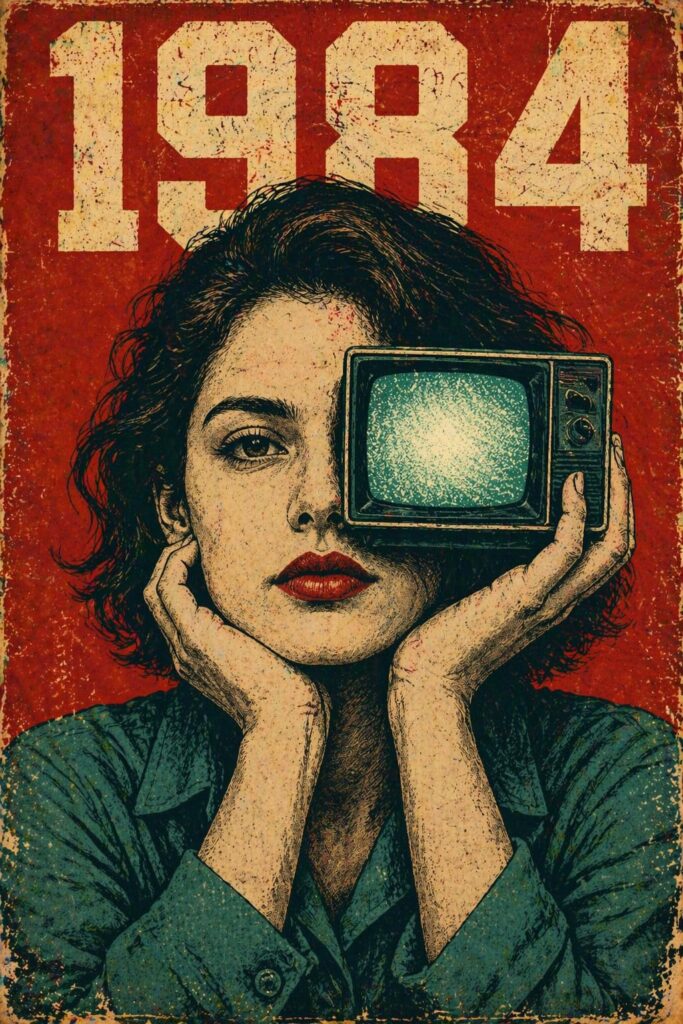
Ultra-detailed retro poster illustration of a young woman in a centered close-up portrait, resting her face on both hands, staring directly forward with a calm yet slightly melancholic expression. One eye is visible and sharp, while the other eye is covered by a small vintage CRT television set held against her face. The TV displays a glowing screen with subtle static texture.
The composition is symmetrical and tightly framed. The woman has short, slightly wavy hair, pale skin tone, and bold red lips. She wears a muted green shirt with visible folds and vintage texture.
Background is a bold, flat red color with heavy distressed textures, scratches, grain, and worn-out poster effects. At the top, large bold typography reads “1984” in an off-white/cream color with a weathered, grunge finish.
Color palette is limited and stylized: teal, red, cream, and black tones. Strong contrast with a screen-printed, vintage propaganda poster aesthetic inspired by mid-century design and dystopian themes.
Art style: retro printmaking, screen print, slightly halftone texture, grainy overlay, aged paper effect, high contrast shadows, graphic novel style, analog noise, subtle ink imperfections.
Lighting: flat but dramatic, with strong color blocking rather than realistic light.
Mood: dystopian, surveillance-themed, nostalgic yet unsettling.
Highly textured, worn paper edges, scratches, dust, and imperfections throughout the image.
About This AI Image Prompt
This prompt creates a retro dystopian poster built around an unusual visual metaphor: a young woman looks directly toward the viewer while a vintage CRT television covers one eye. The television becomes more than a prop; its glowing screen and static texture suggest themes of surveillance, media, technology, and distorted perception.
The tightly framed composition keeps the woman’s face and television as the dominant elements. Resting her face on both hands gives the portrait an intimate quality, while her calm yet melancholic expression introduces emotional tension. The contrast between her direct gaze and the obscured eye makes the viewer question what she can see and what remains hidden.
The bold red background provides a strong graphic foundation, while the muted green shirt and teal television details introduce contrasting colors. The large “1984” typography reinforces the dystopian theme and gives the poster a clear narrative reference. Distressed textures, scratches, dust, and worn paper effects make the artwork feel like an aged printed artifact rather than a modern digital design.
Understanding the Visual Style
The visual style combines retro printmaking, screen-print poster design, dystopian graphic art, mid-century-inspired propaganda aesthetics, and graphic-novel illustration. It deliberately avoids photographic realism in favor of bold shapes, limited colors, and visible printing imperfections.
The screen-printed appearance is strengthened by halftone texture, analog noise, aged paper, and slightly imperfect ink application. These details make the artwork feel physically printed and repeatedly handled.
The flat red background and strong color blocking create an immediate visual impact, while the teal, cream, black, and red palette gives the poster a deliberately restricted color language. The result feels nostalgic but unsettling, using vintage design techniques to communicate themes associated with surveillance and dystopian society.
Technical Prompt Breakdown
Unlike a conventional cinematic photography prompt, this concept is primarily concerned with graphic composition and printmaking characteristics. The image is tightly framed around the woman’s face, hands, and CRT television, creating a compact visual structure.
The composition is described as symmetrical, which gives the portrait a formal poster-like quality. The television covering one eye introduces the main asymmetrical visual element within that otherwise balanced arrangement.
Screen-print characteristics such as halftone texture, grain, analog noise, ink imperfections, distressed surfaces, and aged-paper effects are explicitly requested. These details simulate the physical qualities associated with older printed artwork.
The lighting is intentionally described as flat but dramatic, relying on strong color blocking rather than realistic illumination. This is important because realistic gradients and photographic lighting could weaken the intended graphic aesthetic.
No camera, lens, aperture, ISO, or other photographic specifications are provided, so they should not be invented.
Lighting, Colors & Composition
The artwork relies primarily on color blocking instead of realistic light. The bold red background creates the dominant visual field, while cream typography and muted clothing provide contrast. Teal and black elements introduce cooler tones and strengthen the retro-dystopian palette.
The CRT screen becomes a secondary light source within the illustration because its glowing display contrasts with the flat surrounding colors. Its static texture adds visual noise and reinforces the technological theme.
The tightly cropped face creates immediate intimacy, while the hands framing the cheeks establish symmetry. The television interrupts that symmetry and becomes the central conceptual device.
At the top, the large “1984” title creates a clear graphic hierarchy. Its cream color and distressed finish allow it to remain visible against the red background while fitting naturally into the aged-poster aesthetic.
How to Customize This Prompt
Change the Television
Replace the CRT television with an old radio, surveillance camera, telephone, computer monitor, or vintage video recorder. Each object can communicate a different relationship between people and technology.
Change the Main Color
The red background can be replaced with mustard yellow, deep blue, faded orange, or olive green. Keeping the palette limited to a few colors will preserve the screen-printed appearance.
Change the Typography
Replace “1984” with a fictional year, film title, character name, or short dystopian phrase. Weathered cream or black lettering can maintain the vintage poster hierarchy.
Change the Facial Expression
The melancholic expression can become fearful, emotionless, curious, or subtly defiant. Different expressions can shift the story from nostalgia toward psychological tension or rebellion.
Increase or Reduce the Distressing
Add heavier scratches, torn edges, ink misregistration, faded areas, and paper stains for an extremely aged appearance. For a cleaner vintage poster, reduce the damage while keeping subtle grain and halftone texture.
Best Use Cases
This concept works well for retro movie-poster designs, dystopian artwork, fictional film campaigns, album-style artwork, graphic-design portfolios, social-media visuals, editorial illustrations, and vintage-inspired mood boards. It is particularly useful for projects exploring surveillance, media, technology, or nostalgia. For commercial projects, verify the AI generator’s licensing terms and ensure any typography, references, or third-party visual elements are appropriately licensed.