Copy & use anywhere
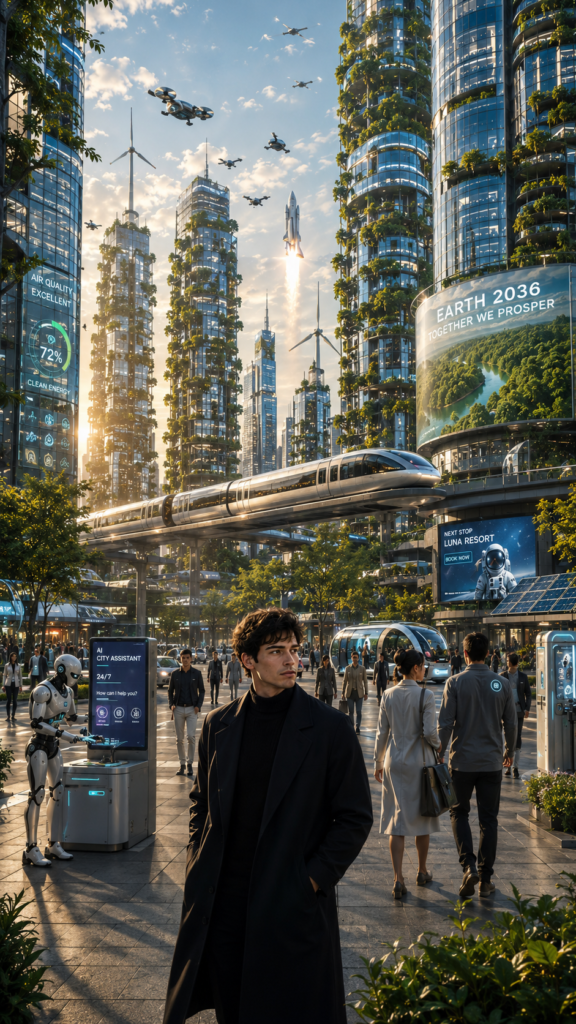
Ultra-realistic cinematic vision of Earth in the year 2036, showing a believable future where technology has naturally evolved over the next 10 years without looking like science fiction. The world's largest cities are transformed with elegant glass skyscrapers covered in vertical forests, autonomous electric vehicles silently moving through smart roads, AI-powered public robots assisting people, and ultra-fast magnetic public transport gliding above the streets. People wear modern minimalist fashion with lightweight smart fabrics, AR contact lenses, and compact wearable AI devices. Delivery drones, flying emergency response vehicles, and robotic maintenance systems operate seamlessly in the background. Streets are cleaner, greener, and powered by renewable energy with solar glass buildings and wind-powered architecture. Giant holographic information displays blend naturally into city life, while parks, rivers, and biodiversity thrive through sustainable urban planning. Homes feature intelligent AI assistants, robotic automation, transparent interactive displays, and energy-efficient designs. Space tourism advertisements appear on digital billboards, and reusable spacecraft can be seen launching in the far distance. Humanoid robots work alongside humans in hospitals, schools, offices, and factories, creating a harmonious coexistence. The atmosphere feels optimistic, peaceful, and technologically advanced while remaining grounded in realism. Hyper-detailed textures, natural human expressions, cinematic golden-hour lighting, volumetric light rays, realistic reflections, 8K HDR, ultra-sharp focus, documentary-style photography, photorealistic skin and architecture, captured on an ARRI Alexa 65 with a 35mm lens, masterpiece quality, highly detailed, believable near-future world, indistinguishable from a real photograph.
About This AI Image Prompt
This AI image prompt imagines a believable version of Earth in 2036, focusing on how technology could become naturally integrated into everyday life rather than creating an exaggerated science-fiction world. The central idea is a future where advanced systems improve transportation, urban planning, sustainability, healthcare, communication, and daily convenience while cities still feel recognizable and human.
The environment combines modern architecture with extensive greenery. Glass skyscrapers incorporate vertical forests, smart roads support autonomous electric vehicles, and high-speed magnetic transport connects different parts of the city. Renewable energy is also treated as part of normal infrastructure through solar glass buildings and wind-powered designs.
People remain an important part of the scene. Their clothing, wearable technology, AR devices, and interaction with AI systems help communicate how ordinary life has evolved.
Robots, drones, holographic displays, and automated services are integrated into the environment rather than presented as dramatic futuristic objects. Parks, rivers, and biodiversity are intentionally preserved, creating a vision of technological progress that exists alongside nature.
Understanding the Visual Style
The visual style combines photorealistic documentary photography, near-future architecture, cinematic environmental storytelling, and realistic technology visualization.
A key characteristic is restraint. The prompt avoids extreme futuristic designs and instead imagines technologies that could plausibly become part of urban life. Clean architecture, autonomous transport, wearable devices, robotics, and digital displays are presented as ordinary infrastructure.
The optimistic atmosphere is supported by clean streets, abundant vegetation, natural human expressions, and warm cinematic illumination. Rather than making technology feel threatening, the composition presents humans and machines working together.
The result should feel like a photograph captured inside a believable future city rather than a conventional science-fiction movie scene.
Technical Prompt Breakdown
The prompt specifies an ARRI Alexa 65 camera with a 35mm lens, along with 8K HDR rendering and documentary-style photography.
The 35mm focal length provides a relatively wide perspective, making it useful for showing architecture, transportation, people, vegetation, and technological infrastructure within the same scene.
The documentary photography direction is particularly important because it encourages the futuristic elements to appear naturally integrated into the environment rather than arranged like theatrical props.
The prompt also calls for realistic reflections, photorealistic architecture and skin, ultra-sharp focus, detailed textures, volumetric light, and HDR. These instructions support the goal of making the imagined future appear convincingly photographic.
Lighting, Colors & Composition
Cinematic golden-hour lighting gives the futuristic environment a warm and optimistic atmosphere. Volumetric rays can add depth around skyscrapers, transportation systems, trees, and public spaces.
The visual palette combines glass blues, natural greens, warm sunlight, neutral architecture, renewable-energy elements, and subtle digital lighting. The greenery provides an important contrast against the modern urban structures.
Composition should balance multiple layers: people and vehicles in the foreground, buildings and public infrastructure in the middle distance, and transport systems or spacecraft extending toward the horizon.
The inclusion of parks, rivers, trees, and clean public spaces prevents the city from becoming visually dominated by technology. This balance reinforces the central message of sustainable progress.
How to Customize This Prompt
Change the City
The future environment can be adapted into a dense Asian megacity, European capital, futuristic Indian city, coastal metropolis, desert city, or green smart city. Local architecture and culture can make the imagined future feel more distinctive.
Change the Technology
You can emphasize autonomous cars, humanoid robots, AR interfaces, magnetic transport, delivery drones, smart buildings, or household AI systems. Focusing on one technology creates a clearer visual theme.
Change the Sustainability Level
The scene can feature extensive vertical forests, rooftop farms, renewable-energy infrastructure, restored rivers, or car-free streets. Increasing the environmental elements creates a stronger eco-futuristic direction.
Change the Time of Day
Golden hour can be replaced with a bright morning, rainy afternoon, blue hour, or futuristic nighttime cityscape. Night scenes allow holographic displays and illuminated transportation systems to become more visually prominent.
Change the Human Perspective
Instead of showing a large city panorama, the concept can focus on a family using an AI-powered home, a commuter boarding magnetic transport, a hospital where robots assist doctors, or students learning alongside AI systems.
Best Use Cases
This concept is suitable for future-city illustrations, technology presentations, educational projects, sustainability campaigns, sci-fi storytelling, digital artwork, blog illustrations, YouTube thumbnails, Pinterest content, concept-art portfolios, and speculative design projects.
If the image is used commercially, check the AI generator’s licensing terms and verify the rights for any recognizable logos, advertisements, trademarks, spacecraft designs, or other third-party visual elements included in the final artwork.