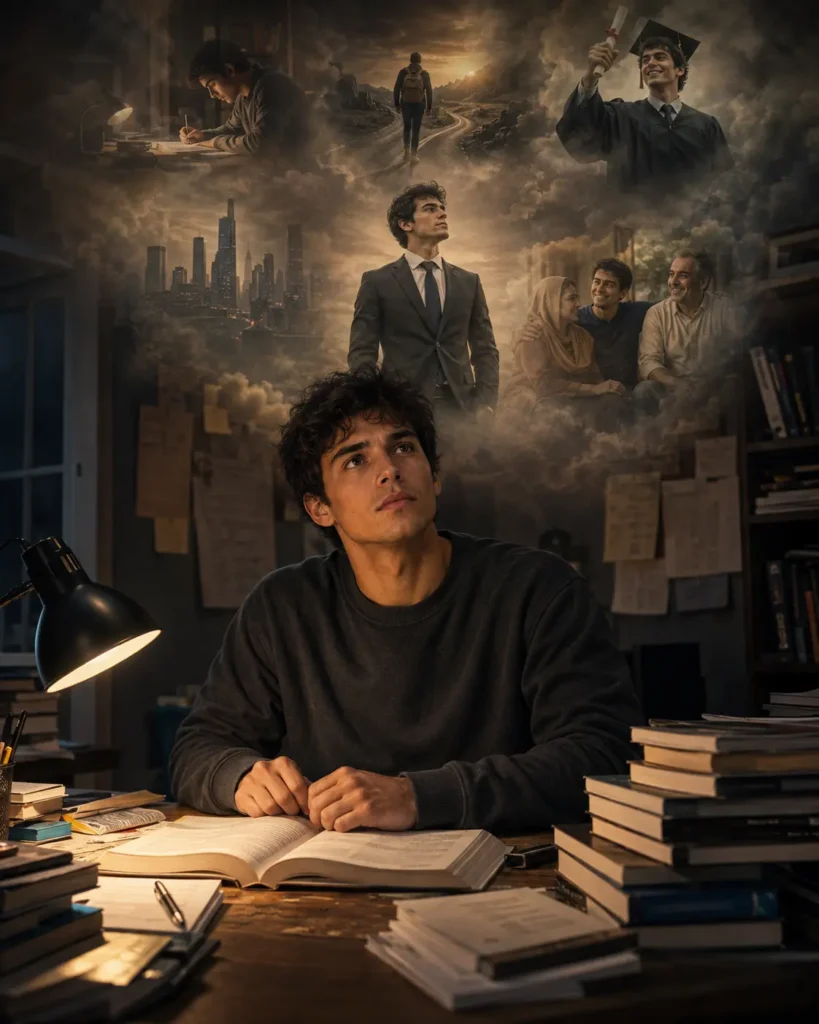
Create an ultra-realistic cinematic portrait of a young South Asian man sitting alone at a wooden study table late at night. He is wearing a simple dark charcoal sweatshirt, with a natural hairstyle and realistic facial features. His posture is calm and thoughtful, with both hands naturally resting on the table near an open book. His head is slightly tilted upward, and his eyes are looking toward the space above him with a thoughtful, hopeful expression.

On the study table, place an open textbook, several slightly messy stacks of books, handwritten notes, loose papers, a pen, and a simple black desk lamp. The lamp provides a soft, warm medium-intensity light that naturally illuminates his face, hands, books, and part of the wooden desk. Keep the rest of the room darker with realistic ambient shadows. The environment should feel like a real student's small bedroom or study room, not a fantasy set.

Above and slightly behind the young man, create a subtle dreamlike vision floating naturally in the air, blending realistically into the surrounding atmosphere. The vision should look like memories and future dreams appearing through soft translucent clouds, gentle mist, and cinematic light—not like separate pasted images.

Inside the floating vision, show symbolic moments from his future and struggles: a tired young man studying alone late at night, difficult roads and obstacles representing struggle, a graduation moment representing achievement, a confident successful version of himself wearing a formal suit standing in a modern city, a distant city skyline representing ambition, and a peaceful moment with his family representing the reason behind his journey. Make every vision element slightly transparent, atmospheric, and naturally integrated into the clouds.

The main subject must remain the strongest and sharpest element of the image, while the future visions gradually fade into the surrounding mist. Create a powerful visual contrast between his present struggle at the study table and the hopeful future he imagines above him.

Natural human anatomy, realistic skin pores, subtle facial imperfections, authentic hair texture, realistic hands and fingers, physically accurate lighting, natural shadows, realistic fabric texture, realistic wooden desk and books, believable indoor environment, no artificial plastic skin.

Shot as a professional cinematic photograph on a Sony A7R IV with an 85mm lens at f/1.8, shallow depth of field, realistic bokeh, soft cinematic lighting, subtle volumetric light, natural color grading, deep but realistic shadows, gentle warm highlights, restrained contrast, fine film grain, HDR, extremely detailed, photorealistic, emotionally powerful, documentary-style realism, 8K UHD quality.

Composition: vertical 4:5 portrait, medium-full shot, eye-level camera with enough space above the subject for the floating future vision, balanced composition, realistic perspective, cinematic depth, no exaggerated fantasy effects, no cartoon appearance, no illustration, no CGI look, no over-saturated colors, no excessive glow, no distorted anatomy.
Dreams Above the Desk: A Cinematic AI Portrait of Struggle and Success
Late-night study sessions often carry more emotion than they appear to from the outside. A desk, an open book, and a small lamp can represent hours of effort, uncertainty, and the hope that things will eventually improve. This AI portrait turns that quiet moment into a visual story: a young man sitting alone at his desk while imagined scenes of his future seem to emerge above him. It is ideal for creators who want an image about ambition without making it feel overly dramatic or artificial.
When Hard Work Becomes the Subject
The visual direction combines cinematic portrait photography with dreamy visual storytelling. Instead of showing success directly, the image suggests it through a subtle vision floating within the atmosphere above the character. That contrast gives the scene an emotional progression: the desk represents the present, while the imagery overhead hints at where his effort could lead.
The setting remains grounded and believable. A wooden study table, an open book, and a modest lamp create the feeling of a real bedroom or personal study space. Warm illumination around the desk can be balanced with cooler, softer darkness in the surrounding room, making the subject feel isolated but not hopeless.
Details That Shape the Story
The slightly upward head position is one of the most important visual decisions. Rather than staring directly into the camera, the subject looks toward the imagined future above him. That small change in posture makes the portrait feel reflective and gives the floating imagery a natural reason to exist within the scene.
The lighting also carries emotional meaning. The desk lamp provides a believable practical light source, gently illuminating the hands, book, clothing, and face. Beyond that pool of light, the room falls into controlled shadow. This creates a visual metaphor for moving from uncertainty toward possibility.
Another useful element is soft atmospheric blending between the real room and the dreamlike vision. The future scenes should feel as though they are appearing naturally in the air, with subtle transparency and depth rather than looking like separate pictures pasted onto the background.
Personalizing the Dream Sequence
The imagined future can be adapted to match the story you want the portrait to tell.
- Career-focused version: Show subtle visual hints of a future office, creative studio, technology workspace, or professional achievement above the desk.
- Entrepreneurial version: Replace career imagery with a growing business, product ideas, a recognizable workspace, or a symbolic vision of financial independence.
- Personal-growth version: Keep the future abstract, using imagery such as a confident version of the same person, a brighter city skyline, travel destinations, or a peaceful home.
For a more emotional result, keep these elements understated. The image becomes stronger when viewers notice the dreamlike details gradually rather than seeing an obvious fantasy scene immediately.
Where This Concept Fits Naturally
This portrait is especially suitable for motivation websites, personal-growth articles, Instagram storytelling posts, AI photography portfolios, and inspirational social media campaigns. It can also work as a feature image for content about studying, career uncertainty, perseverance, or building a better future.
What Happened When I Tested It
I tested this concept in chatgpt, and the most convincing results came when I kept the future imagery slightly hazy instead of making it extremely bright. One issue I noticed was that overly detailed dream elements competed with the subject and book. Reducing the number of visible future scenes helped the image feel more photographic. I also kept the lamp believable as the main light source, which made the final atmosphere much more natural.