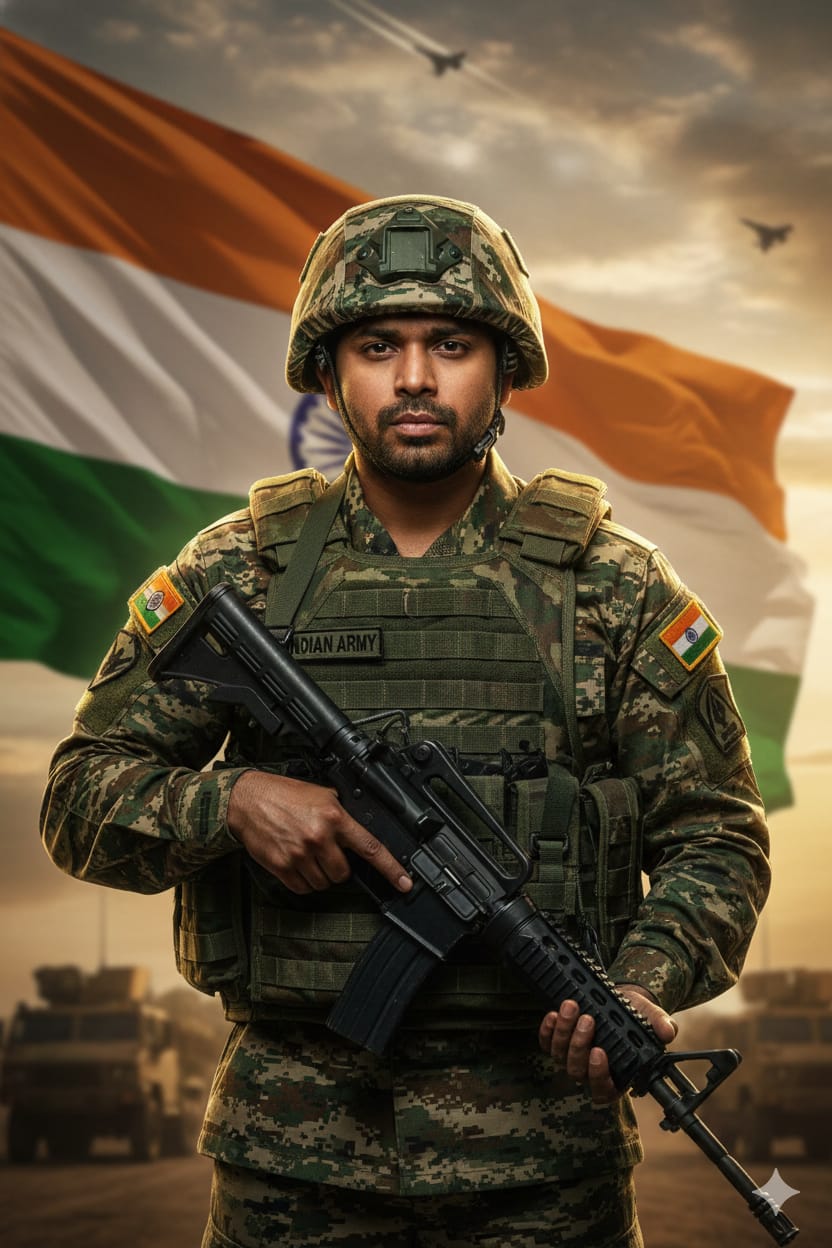
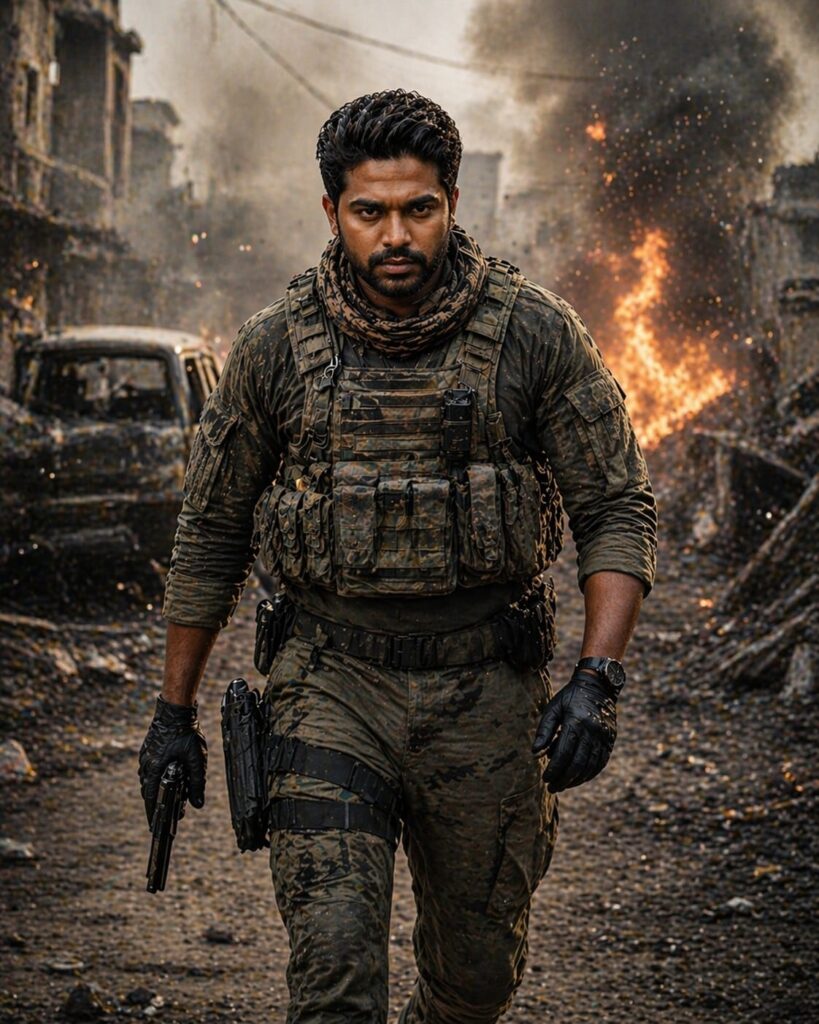
Ultra-realistic cinematic war scene of a young Indian male soldier walking forward in a destroyed urban battlefield. He has natural brown skin with realistic skin texture, visible pores, light sweat, dust, and dirt on his face. Short slightly messy curly hair, thick eyebrows, trimmed beard, intense focused expression, sharp eyes looking forward.

He is wearing modern tactical military gear: camouflage uniform, detailed combat vest with multiple pouches, gloves, knee pads, and rugged boots. His uniform and gear are dirty, worn, and covered in dust and mud with highly detailed fabric textures.

He is holding a handgun naturally in his right hand, finger off the trigger, relaxed but ready stance.

Background shows a realistic war-torn city: broken buildings, burned vehicles, rubble-filled road, ash and dust particles in the air. A realistic explosion is happening behind him with controlled flames, glowing embers, sparks, and thick dark smoke rising upward (not overexposed).

Lighting is cinematic and natural: soft diffused daylight mixed with warm fire backlight, subtle rim lighting around the subject, realistic shadows on face, balanced exposure.

Camera style: 85mm lens look, shallow depth of field, subject in sharp focus, background slightly blurred, slight motion blur on debris only.

Color grading: cinematic, muted tones, earthy colors, realistic contrast, no oversaturation, no artificial glow.

Rendering: ultra-detailed, photorealistic, 8K resolution, HDR, volumetric smoke and lighting, realistic physics, natural sharpness, subtle film grain, slight chromatic aberration, no cartoon look.
About This AI Image Prompt
This prompt is designed to create a gritty, photorealistic cinematic scene centered on a young Indian soldier moving through a devastated urban battlefield. The character is presented as the primary subject, while the destroyed buildings, rubble, smoke, fire, and damaged vehicles establish the scale and seriousness of the environment.
A major strength of the concept is its attention to realistic surface details. Dust, sweat, dirt, worn fabric, and damaged equipment help connect the character visually to the surrounding battlefield. His focused expression and forward movement communicate determination while keeping the scene grounded in a cinematic storytelling style.
The background explosion adds energy without becoming the main subject. Controlled flames, sparks, embers, and smoke provide environmental movement while the soldier remains clearly visible. The combination of muted colors, natural lighting, realistic textures, and restrained visual effects is intended to make the scene resemble a frame from a serious war film rather than an exaggerated action illustration.
Understanding the Visual Style
The visual style combines cinematic war photography, realistic action-film imagery, military drama, and Hollywood-style film still composition. The emphasis is on realism rather than stylized action effects.
The character’s worn clothing and dusty appearance contribute to a grounded visual language. The ruined city creates a bleak atmosphere, while the mixture of daylight and firelight introduces cinematic contrast.
The restrained color grading is particularly important. Earthy, muted tones prevent the scene from becoming overly saturated, while subtle film grain and controlled atmospheric effects add a film-inspired quality. The overall result is intended to feel tense, immersive, and physically believable.
Technical Prompt Breakdown
The prompt specifies an 85mm lens look and shallow depth of field, keeping the soldier sharply defined while allowing the damaged city and explosion behind him to become somewhat softer. This helps establish the character as the primary focal point.
The prompt also calls for slight motion blur on airborne debris rather than the main subject. This distinction helps communicate movement while preserving facial and clothing detail.
Lighting combines soft diffused daylight with warm fire backlighting and subtle rim lighting. Rim lighting creates a narrow highlight around the subject’s outer edges, helping separate him from the smoky background.
HDR, volumetric smoke, realistic physics, subtle film grain, and slight chromatic aberration are included as rendering and visual-treatment instructions. No specific camera body, aperture, ISO, or shutter speed is provided, so those details should not be invented.
Lighting, Colors & Composition
The scene uses a balanced mixture of cool natural daylight and warm illumination from the explosion. The daylight provides realistic overall exposure, while the fire creates warmer highlights around the subject and surrounding smoke.
Muted earthy colors dominate the scene through the soldier’s uniform, dust, concrete rubble, and damaged buildings. Warm orange fire tones become a controlled accent rather than overwhelming the image.
The soldier’s forward movement creates a strong central visual direction. The damaged road and surrounding structures can naturally guide the viewer’s attention toward him. Keeping the background slightly blurred prevents the destruction from overpowering the character.
Smoke, ash, embers, and debris add multiple depth layers, making the environment feel expansive and active while maintaining a clear focal point.
How to Customize This Prompt
Change the Environment
Replace the destroyed urban battlefield with a rural conflict zone, abandoned industrial area, mountainous terrain, ruined village, or dusty road. The environment can change the scale and atmosphere of the fictional scene.
Change the Lighting
Replace the daylight-and-fire combination with overcast skies, sunrise, nighttime illumination, or strong backlighting. Nighttime lighting can create a more suspenseful mood, while overcast conditions produce a colder and more subdued appearance.
Change the Character’s Movement
Instead of walking forward, the soldier could be standing beside damaged vehicles, moving through smoke, taking cover, or observing the distant environment. Different poses can shift the image from action-oriented to reflective storytelling.
Change the Color Grade
Experiment with desaturated blue-gray tones, warm sepia, neutral documentary-style grading, or muted green and brown tones. Keeping saturation controlled will help preserve the realistic cinematic appearance.
Modify the Background Action
The explosion can be replaced with drifting smoke, distant fire, falling dust, damaged vehicles, or sunlight cutting through the haze. Reducing background action can create a quieter and more character-focused scene.
Best Use Cases
This visual concept can work for fictional war-film artwork, cinematic storyboards, military-drama concepts, character posters, game-inspired visual development, creative portfolios, mood boards, and dramatic storytelling projects. It is best treated as fictional cinematic artwork rather than documentary imagery. For commercial projects, check the AI generator’s licensing terms and ensure any uniforms, insignia, logos, locations, or third-party assets used in the final artwork are appropriately licensed.