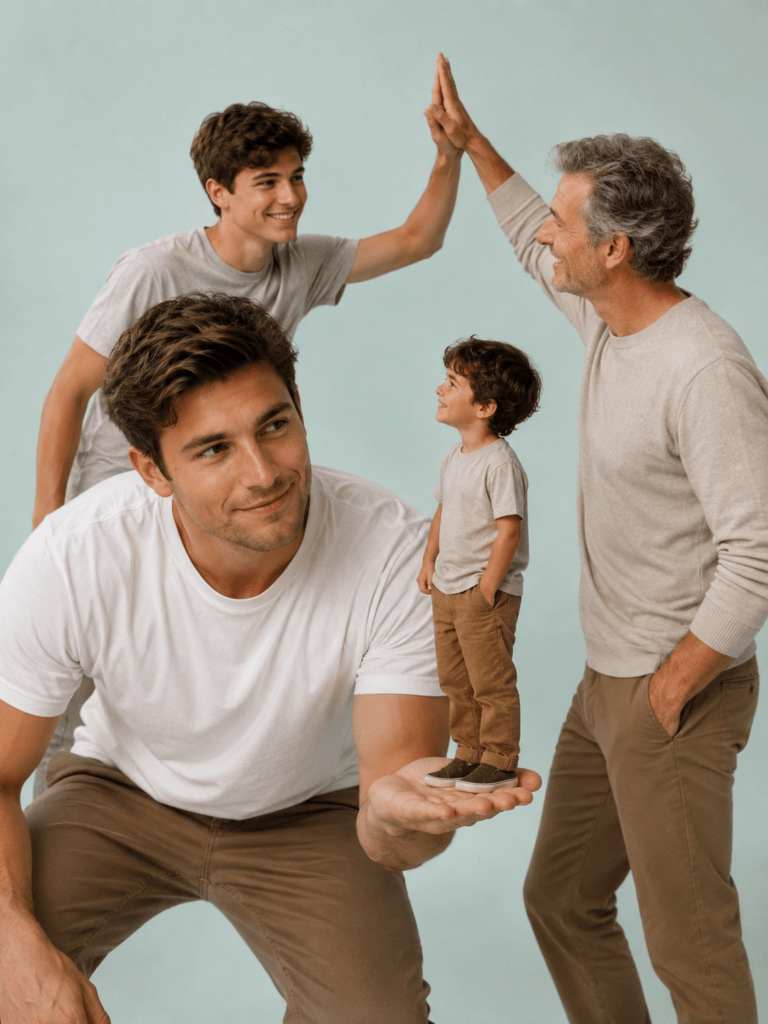
Ultra-realistic surreal forced-perspective lifestyle portrait of the SAME PERSON from the uploaded reference image appearing in four different life stages together in one frame: 5-year-old child, teenage version, young adult, and elderly version. Creative optical illusion composition where the young adult version crouches naturally while holding the tiny child version standing realistically on his palm, while the teenage and elderly versions interact in the background with a playful high-five and relaxed candid body language.

Every age version must preserve the EXACT same facial identity, bone structure, eye shape, eyebrows, nose, lips, jawline, hairstyle texture, skin tone, and overall likeness from the uploaded face, making all ages instantly recognizable as the same human. Scientifically realistic age progression with authentic wrinkles, natural gray hair, believable skin aging, realistic facial fat changes, and genetically accurate anatomy.

The scene must feel naturally captured and emotionally authentic, like a premium magazine photoshoot with spontaneous interactions. Nobody is looking directly at the camera. Natural expressions, soft smiles, relaxed posture, candid movement, realistic hand placement, believable proportions, and physically accurate forced perspective scaling.

Shot in a minimalist luxury photography studio with a clean soft pastel background, cinematic soft diffused lighting, subtle shadows, shallow depth of field, DSLR realism, Leica lens look, hyper-realistic skin pores, authentic eyes, natural fabric textures, premium editorial composition, Vogue-style creative photography, raw photo realism, realistic color grading, 8k ultra detailed, lifelike human detail.

NEGATIVE PROMPT: looking at camera, cartoon, illustration, anime, CGI, fake perspective, unrealistic scaling, distorted anatomy, duplicate faces, extra limbs, bad hands, plastic skin, doll face, over-smooth skin, blurry eyes, unrealistic wrinkles, low quality, fantasy art, artificial lighting, oversaturated colors, stiff posing, deformed proportions, uncanny valley, stylized art, fake shadows.
About This AI Image Prompt
This prompt creates a surreal but photorealistic portrait showing the same person at four different stages of life within one scene: childhood, adolescence, young adulthood, and old age. The creative concept combines age progression with forced perspective, turning a family-like gathering into an optical illusion where different versions of one individual interact naturally.
The young adult version acts as the visual anchor by crouching and holding the much smaller child version on an open palm. Meanwhile, the teenage and elderly versions interact in the background, creating the impression of a spontaneous gathering between different points in the same person’s life.
Identity preservation is central to the concept. The prompt asks each age version to retain recognizable facial characteristics while allowing age-specific changes such as wrinkles, gray hair, and differences in facial fullness. This balance is important: the characters should look like distinct ages while still communicating that they represent the same individual.
The minimalist studio setting keeps attention on the unusual interaction. Soft lighting, natural expressions, realistic proportions, and candid body language are used to make the impossible scenario feel like a genuine editorial photograph.
Understanding the Visual Style
The visual style combines conceptual portrait photography, surreal forced perspective, lifestyle photography, and luxury editorial imagery. The surreal element comes from placing multiple life stages of one person together, but the photographic treatment remains grounded in realism.
The candid behavior is particularly important. Instead of having every version pose toward the viewer, the prompt asks them to interact naturally and avoid direct eye contact with the camera. This makes the scene resemble a carefully photographed spontaneous moment rather than a conventional composite portrait.
The minimalist luxury studio and soft pastel background provide a clean visual environment. This simplicity allows the differences between childhood, youth, adulthood, and old age to become the main storytelling device.
Technical Prompt Breakdown
The most important technical instruction is forced-perspective scaling. Forced perspective is an optical technique where objects at different distances are positioned so they appear dramatically different in size. Here, the child is positioned and scaled to appear small enough to stand naturally on the young adult’s palm.
The prompt also specifies a shallow depth of field, soft diffused lighting, DSLR realism, and a Leica lens look. These instructions establish a photographic rather than illustrated appearance. Hyper-realistic skin pores, authentic eyes, natural fabric textures, and realistic color grading add further surface detail.
The age-progression instructions describe realistic wrinkles, gray hair, changes in facial fullness, and natural skin aging. These details are intended to make the different life stages believable while preserving recognizable identity.
The negative prompt specifically rejects distorted anatomy, duplicate faces, incorrect scaling, unnatural hands, plastic-looking skin, and artificial expressions. These constraints are especially relevant to a multi-person forced-perspective composition.
Lighting, Colors & Composition
The soft pastel studio background provides a quiet foundation for the composition, while diffused cinematic lighting creates gentle illumination across the different age versions. Subtle shadows are important because they help ground each figure within the same physical environment.
The composition uses distance and scale as major visual tools. The child occupies a visually small position on the adult’s palm, while the teenage and elderly versions remain farther back. This creates multiple layers of depth within one frame.
The absence of direct eye contact makes the scene feel more candid. The high-five and relaxed interactions also create movement and emotional connection between the different versions. Natural hand placement and believable proportions are particularly important because forced perspective can easily look artificial if body relationships are inconsistent.
The restrained color treatment keeps attention on the people rather than distracting background elements.
How to Customize This Prompt
Change the Life Stages
You can use different age points, such as toddler, teenager, adult, middle-aged, and elderly. Adding more stages can create a broader visual timeline, while fewer stages may produce a cleaner composition.
Change the Interaction
Replace the palm illusion with another interaction, such as the adult holding the child’s hand, the older version sitting beside the younger version, or different ages sharing an object. The interaction can change the emotional message of the image.
Change the Environment
Move the concept from a studio into a childhood bedroom, family home, garden, schoolyard, or meaningful outdoor location. A personal environment can make the age-progression concept feel more nostalgic.
Adjust the Mood
Use subtle smiles for warmth, thoughtful expressions for nostalgia, or playful interactions for a lighter concept. The emotional direction can transform the same optical illusion into a very different story.
Change the Perspective
Experiment with wider environmental framing or a closer composition focused on the adult and child. More environmental space emphasizes the surreal scale relationship, while tighter framing increases attention to facial identity and interaction.
Best Use Cases
This concept is useful for creative portraits, family-inspired artwork, personal storytelling, social-media content, photography portfolios, conceptual editorial projects, birthday or milestone visuals, and nostalgic mood boards. It can also demonstrate creative possibilities in AI portrait generation. When using a reference person’s likeness, obtain appropriate permission, and for commercial projects check the AI generator’s licensing terms and any applicable rights for the reference image.