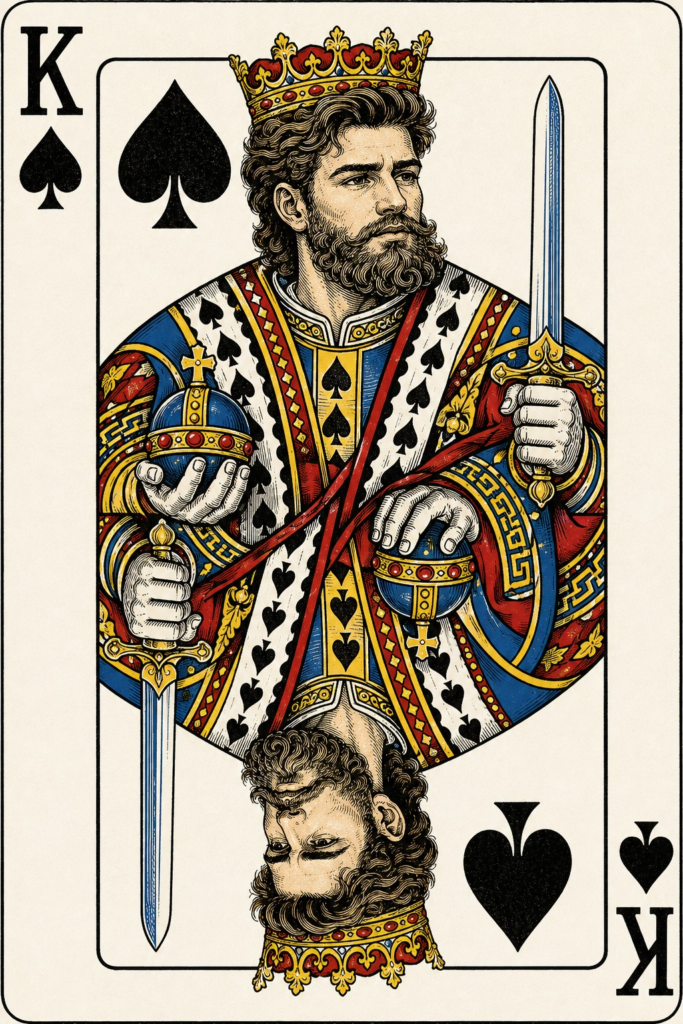
Transform the uploaded portrait into an authentic vintage King of Spades playing card, using the provided playing-card reference as the MASTER reference for composition, pose, face direction, hair, beard, costume and illustration style.

PERSON IDENTITY:
Use the uploaded photo to preserve the person's recognizable facial identity, facial proportions, skin tone, eyebrows, eyes, nose, lips, jawline and distinctive features. The final king must clearly look like the uploaded person.

REFERENCE POSE & FACE DIRECTION:
Do NOT copy the person's original photo pose or facial direction. Adapt and redraw their face into the SAME three-quarter head direction, angle, gaze and head positioning as the reference King card. If the uploaded photo is front-facing, side-facing or smiling, intelligently reconstruct the face into the reference card's strong three-quarter royal pose while preserving the person's identity.

EXPRESSION:
Give the person a serious, powerful, intimidating royal expression: narrowed confident eyes, firm closed lips and strong jaw. Remove any smile or friendly expression.

HAIR & BEARD — IMPORTANT:
Give the king the SAME distinctive FULL, large, flowing, curly vintage hair and LARGE, thick, long curled king-style beard shown in the reference card, regardless of the uploaded person's hairstyle or facial hair. Add a prominent curled moustache connected to the beard. Make the hair and beard highly detailed with bold black ink, curls, engraving and cross-hatching.

KING DESIGN:
Dress the person as the same traditional Renaissance playing-card king shown in the reference: ornate crown, elaborate red/blue/gold royal clothing, decorative collar, jewelry, patterned sleeves, royal accessories and vertical ceremonial sword. Match the reference's proportions, hand positions and overall character arrangement.

PLAYING CARD:
Create the classic reversible King of Spades layout with cream card paper, thin rounded black border, inner frame, large K and Spade symbols in the corners, upright king on the top half and the EXACT SAME king upside-down on the bottom half, seamlessly connected at the center.

STYLE:
Authentic antique playing-card illustration, bold black outlines, woodcut engraving, detailed cross-hatching, stippling, hand-drawn linework, flat red/blue/gold/black colors, cream paper and subtle vintage print texture. No photorealism.

MOST IMPORTANT:
Uploaded photo = PERSON'S IDENTITY.
Reference card = FACE DIRECTION + POSE + HAIR + BEARD + COSTUME + HANDS + SWORD + COMPOSITION + ART STYLE.

Do not create a generic king. Do not paste the photograph onto the card. Do not preserve the original photo's smile or pose. Do not use modern hair or a small beard. Do not add names, logos, watermarks or extra text.

The final result must look like the uploaded person was originally illustrated as the SAME classic King of Spades character from the reference card.
This prompt is designed to transform a personal portrait into an antique-style King of Spades playing card while preserving the recognizable identity of the uploaded person. The concept does not simply place a photograph inside a card template. Instead, the person is reinterpreted as a hand-drawn royal character using the visual language of traditional playing-card illustration.
The provided playing-card reference acts as the master visual guide for the composition, pose, facial direction, costume, hair, beard, sword, and illustration treatment. This distinction is important: the uploaded photograph establishes who the king is, while the reference determines how that person should be visually reconstructed.
The face is adapted into the strong three-quarter royal position of the reference rather than retaining the original photograph’s pose or expression. The serious expression, powerful gaze, large vintage hair, curled beard, and prominent moustache reinforce the character’s authoritative identity.
The reversible card layout completes the transformation. Cream paper, decorative borders, corner symbols, royal clothing, and the mirrored lower figure make the result resemble an authentic vintage playing card rather than a modern digital poster.
Understanding the Visual Style
The visual style combines antique playing-card illustration, woodcut engraving, Renaissance-inspired character design, and vintage printmaking. It deliberately avoids photographic realism.
Bold black outlines provide the primary structure, while cross-hatching, stippling, and engraved linework create shading and texture. Instead of smooth digital gradients, the portrait should appear constructed from carefully placed printed marks.
The red, blue, gold, black, and cream palette reflects the limited colors commonly associated with traditional playing-card artwork. The restrained palette also helps unify the portrait with the surrounding card design.
The royal costume, crown, sword, decorative collar, and jewelry establish the character as a classic king. The reversible structure gives the card its unmistakable traditional playing-card identity.
Technical Prompt Breakdown
This concept relies more on illustration and printmaking techniques than photographic camera specifications. No camera body, lens, aperture, ISO, or shutter speed is relevant to the requested visual style.
The identity reference and master card reference have different functions. The uploaded portrait provides facial characteristics such as proportions, eyes, nose, lips, jawline, skin tone, and distinctive features. The playing-card reference controls the pose, face direction, hairstyle, beard design, clothing, hands, sword, and overall composition.
Engraving techniques such as cross-hatching and stippling create tonal variation. Bold outlines define important forms, while dense linework can provide darker shadows and visual depth.
The reversible layout requires careful symmetry: the upper king and inverted lower king should represent the same character and connect naturally at the center.
Lighting, Colors & Composition
Traditional playing-card illustration does not depend on realistic photographic lighting. Instead, depth is communicated through line density, cross-hatching, stippling, and controlled blocks of color.
The cream card surface provides the visual foundation. Black ink establishes outlines and shadows, while red, blue, and gold accents define the royal clothing and decorative elements.
The composition is highly structured. A thin rounded black border surrounds the card, with an inner frame providing additional separation. Large K and Spade symbols occupy the corners, while the royal figure fills the central illustrated area.
The upper and lower halves mirror each other around the centerline. Maintaining consistent costume details, facial identity, sword placement, and proportions helps the result feel like a genuine reversible playing card.
How to Customize This Prompt
Change the Card Suit
The same concept can be adapted into a King of Hearts, Diamonds, or Clubs by changing the corner symbols and appropriate color treatment. The character’s royal costume can also be adjusted to complement the selected suit.
Modify the Royal Costume
Experiment with different Renaissance-inspired colors, decorative collars, patterned sleeves, crowns, or jewelry while maintaining the vintage engraved construction. Richer details can make the character feel more elaborate.
Adjust the Engraving Density
Increase cross-hatching for a darker, more dramatic antique print or use finer linework for a cleaner vintage card appearance. Stippling can also be emphasized around facial shadows and clothing folds.
Change the Card Aging
Add subtle paper discoloration, faded ink, tiny print irregularities, or worn edges to create a more aged appearance. Keeping these effects restrained helps preserve the important artwork and symbols.
Customize the Expression
The strong narrowed gaze and firm mouth can remain authoritative, or the expression can become slightly more stern and regal. Avoid a friendly smile if the goal is to preserve the intimidating royal character.
Best Use Cases
This concept can work well for personalized playing-card artwork, Pinterest content, collectible-style designs, creative portraits, fantasy-inspired branding, digital art collections, social media visuals, personalized gifts, and historical-inspired creative projects. It can also serve as inspiration for custom character cards or themed playing-card sets. For commercial use, verify the AI generator’s licensing terms and ensure you have appropriate rights to the uploaded portrait and any reference artwork used as a visual guide.